The operating system your revenue team has been building around.
Your CRM records what already happened. PILLAR tells you what is about to. Scoring, signals, coaching and decision routing in one governed engine, so every team works from the same picture.
PILLAR OS gives every role a fit-for-purpose view of the same governed data - from board-level financial cascades down to the field-level save play.
■ Account Intelligence
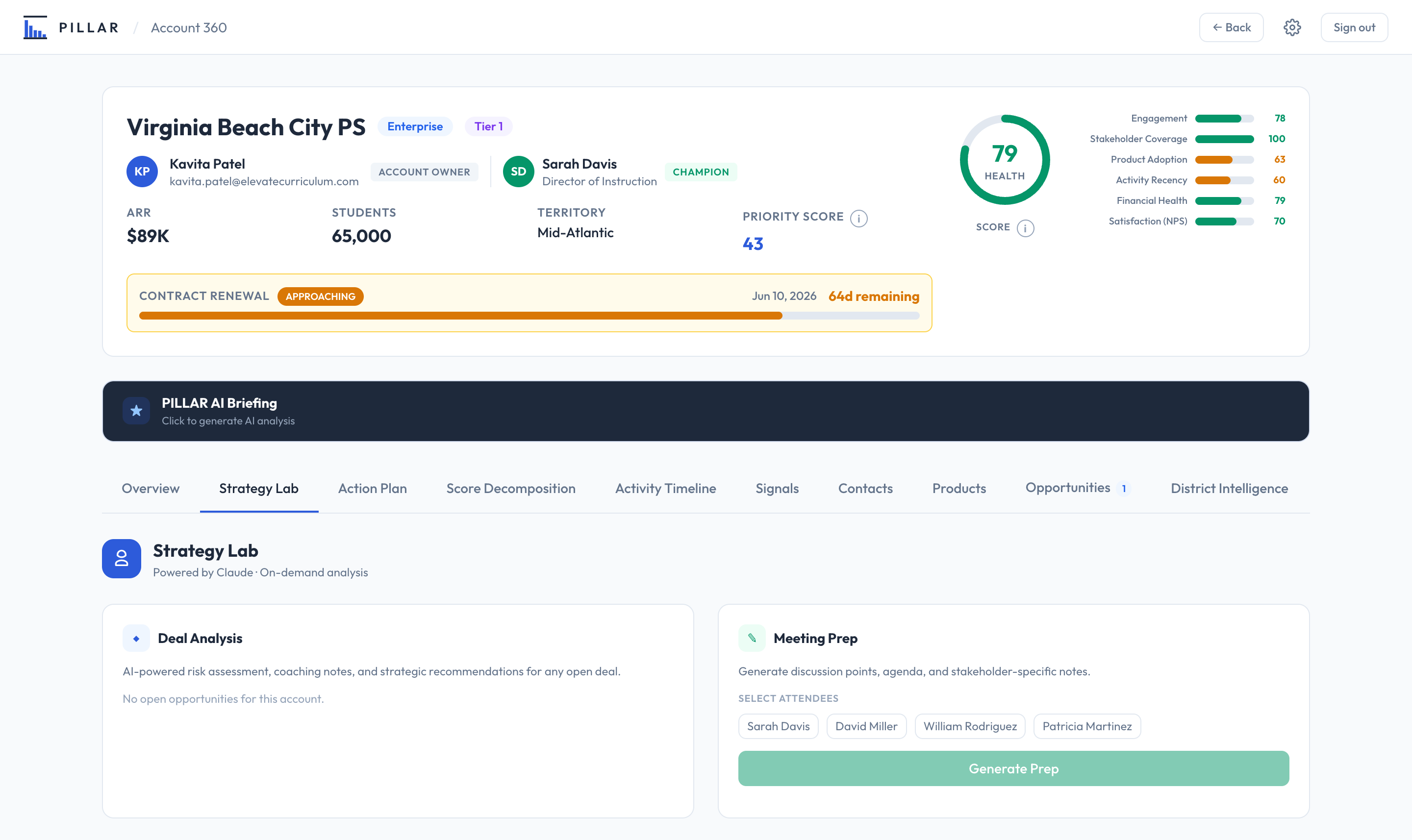
Account 360: every account, the full picture.
Stop prepping for calls across six tabs. Every account gets a unified view that connects pipeline history, renewal risk, expansion signals, contact engagement, and territory context - on one screen.
Scoring decomposition shows you exactly which factors are driving the health score. Contact maps show champions, decision-makers, and detractors. Product adoption matrices highlight expansion whitespace. Everything is sourced, timestamped, and explainable.
Unified scoring - pipeline, renewal risk, and expansion in one composite view
Score decomposition - every factor behind the health score, fully auditable
Product adoption matrix - usage depth across the full product suite
Why it mattersYour AEs and CSMs stop guessing which accounts deserve their time today - and start showing up to every call prepared.
🔒 app.pillargtm.com/accounts/houston-isd
⚡ Real-Time Intelligence
Signal Intelligence: the fires you can't afford to miss.
PILLAR generates real-time signals across 99+ rules spanning pipeline hygiene, renewal risk, expansion readiness, engagement patterns, and district intelligence. Every signal explains what happened, why it matters, and what to do next.
Critical alerts cut through the noise so your team acts on what matters. Each signal is scored for severity, mapped to an account, tied to a recommended play, and traceable back to the rule that fired it.
30+ signal types - pipeline, renewal, expansion, engagement, district intel
Severity scoring - critical, high, medium, low with weighted impact
Auto-triggered plays - each signal can launch a recommended action
STARBRIDGE signals - district enrollment, funding, leadership, and policy
Why it mattersYour team stops reacting to problems after they hit the forecast - and starts catching them while there's still time to act.
🔒 app.pillargtm.com/signals
📊 Financial Intelligence
Revenue Economics: the math behind every territory.
Unit-level clarity: cost-to-acquire, cost-to-serve, cost-to-yield per territory, per segment, per rep. The numbers your board wants - computed automatically from the same source data your reps work from.
Territory P&L shows you exactly which regions are profitable and which are burning cash. Territory equity ensures your reps aren't inheriting broken territories. TAM/SAM modeling connects headcount plans to market opportunity.
Territory P&L - revenue, cost, and margin per territory in real time
Territory equity - balanced distribution across reps and regions
TAM/SAM modeling - market sizing across 17,200 institutions
NRR, GRR, CAC payback - the efficiency metrics your board tracks
Why it mattersYour board decks stop being built the night before the meeting by reconciling four dashboards by hand.
🔒 app.pillargtm.com/territory
🏛 Strategic Intelligence
Decision Engine: from signal to board decision.
The Decision Engine traces how a single signal cascades into financial impact, territory rebalancing, and headcount implications. It's the strategic layer that connects field activity to board-level decisions - with the attribution chain intact.
Four panes, one model: territory health overview, financial cascades from at-risk accounts, rebalance recommendations the engine generates itself, and three board-ready scenarios projected from current operational data.
Territory health - live health score per territory with 5-component breakdown
Financial cascades - ARR-at-risk by signal, NRR drag, cost-to-yield drift
Board scenarios - current trajectory, optimized execution, downside risk
Why it mattersYou can finally answer "did the play actually work?" - and defend every number you present to the board.
🔒 app.pillargtm.com/decision-engine
AI Coaching Layer
Coaching at every altitude.
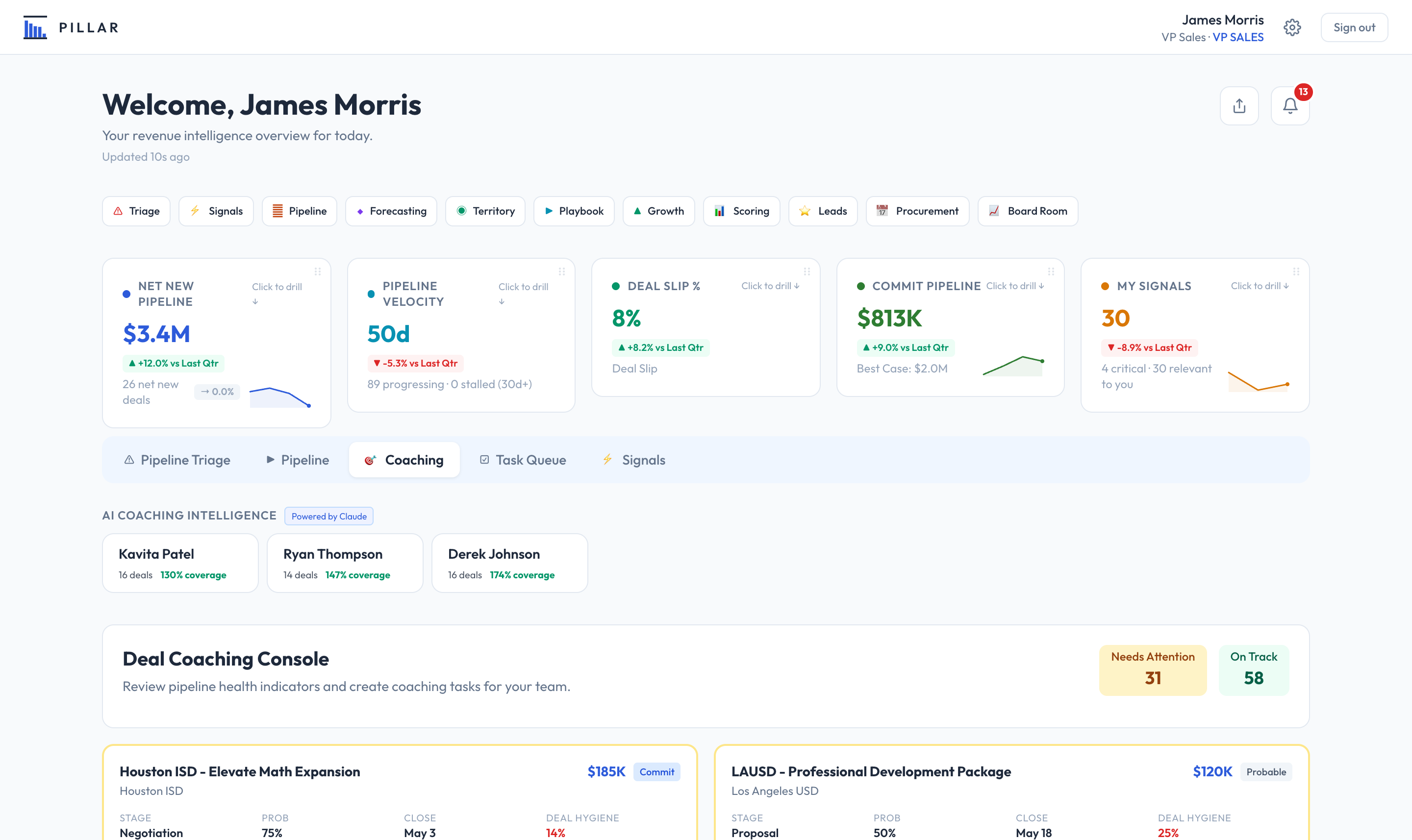
The same AI Coaching Layer powers two different surfaces. At the seat, the Strategy Lab gives every rep a per-deal strategist. At the leader's desk, the Coaching Console rolls those signals into per-rep patterns and 1:1 priorities. Same engine, two lenses, zero handoff loss.
Seat Level · AE / CSM
Strategy Lab - per deal, per rep.
Every account opens a personal AI strategist. Signal history, engagement patterns, stakeholder map, and the plays most likely to move this deal - surfaced where the rep already works.
The same coaching engine rolled up to the team. AI Coaching Intelligence per rep, deal-level needs-attention vs. on-track, and the exact accounts to focus this week's 1:1s on.
🔒 app.pillargtm.com/command - Coaching
I
Per-deal coaching
The AI reads the signal history, scoring changes, and engagement data for each account - then recommends specific next actions with context-aware talk tracks.
II
Per-rep patterns
Across each rep's full portfolio, the AI identifies patterns in win and loss behavior - and flags when a current deal is on a familiar losing trajectory.
III
Meeting prep & plays
Review templates for pipeline reviews, renewals, and QBRs - prefilled with the account's latest state, stakeholder map, and the plays most likely to move the deal.
IV
Manager summaries
For sales and CS leaders: automated summaries of coaching delivered per territory, patterns across the team, and where to focus 1:1s this week.
Built for Every Seat
Seven roles. One system.
Every role sees exactly what they need and nothing they don't. Same data, different lens. Click a role to see the screen they log into every morning.
🔒 app.pillargtm.com/command - Board Report
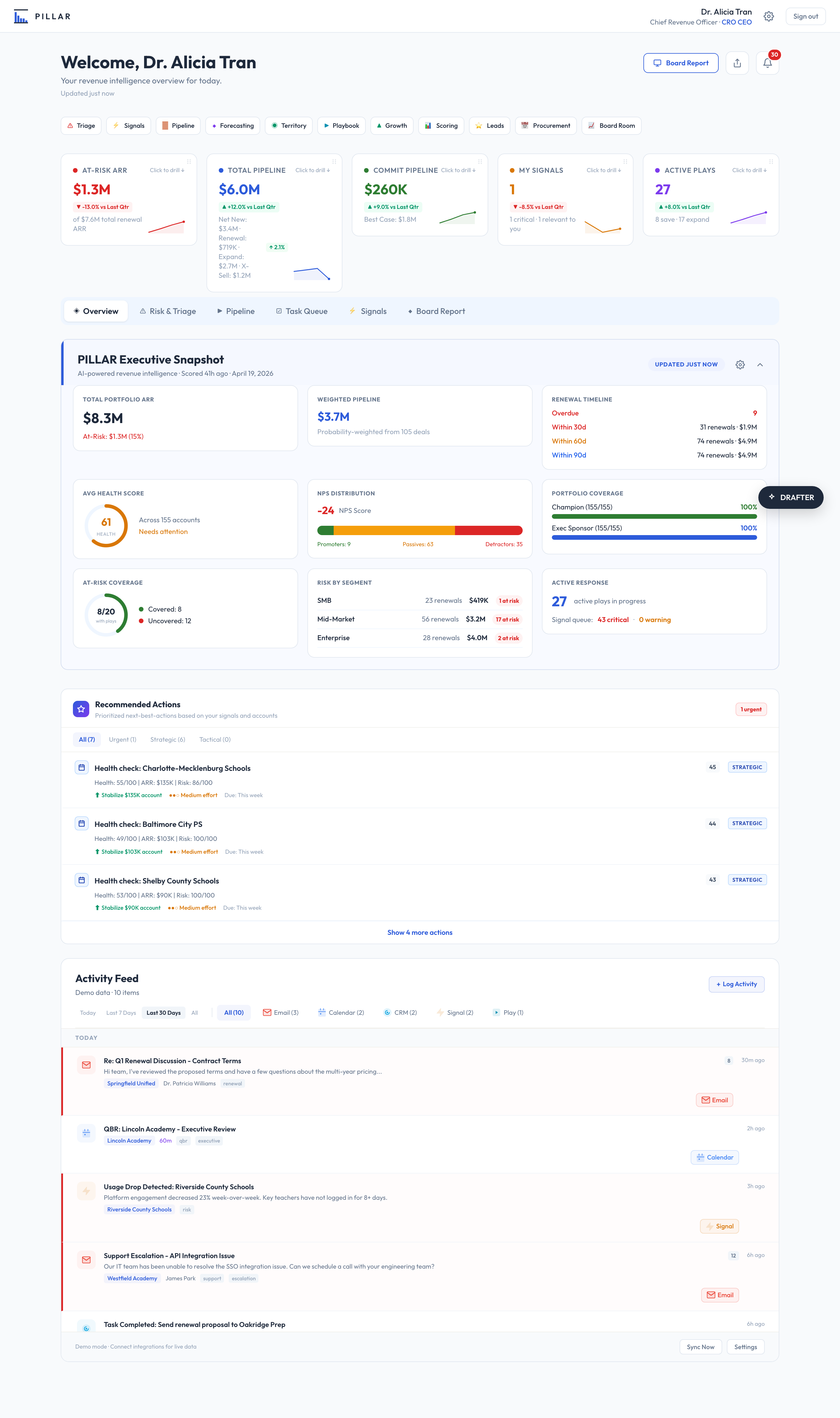
Viewing as CRO / CEO
Captured from live login
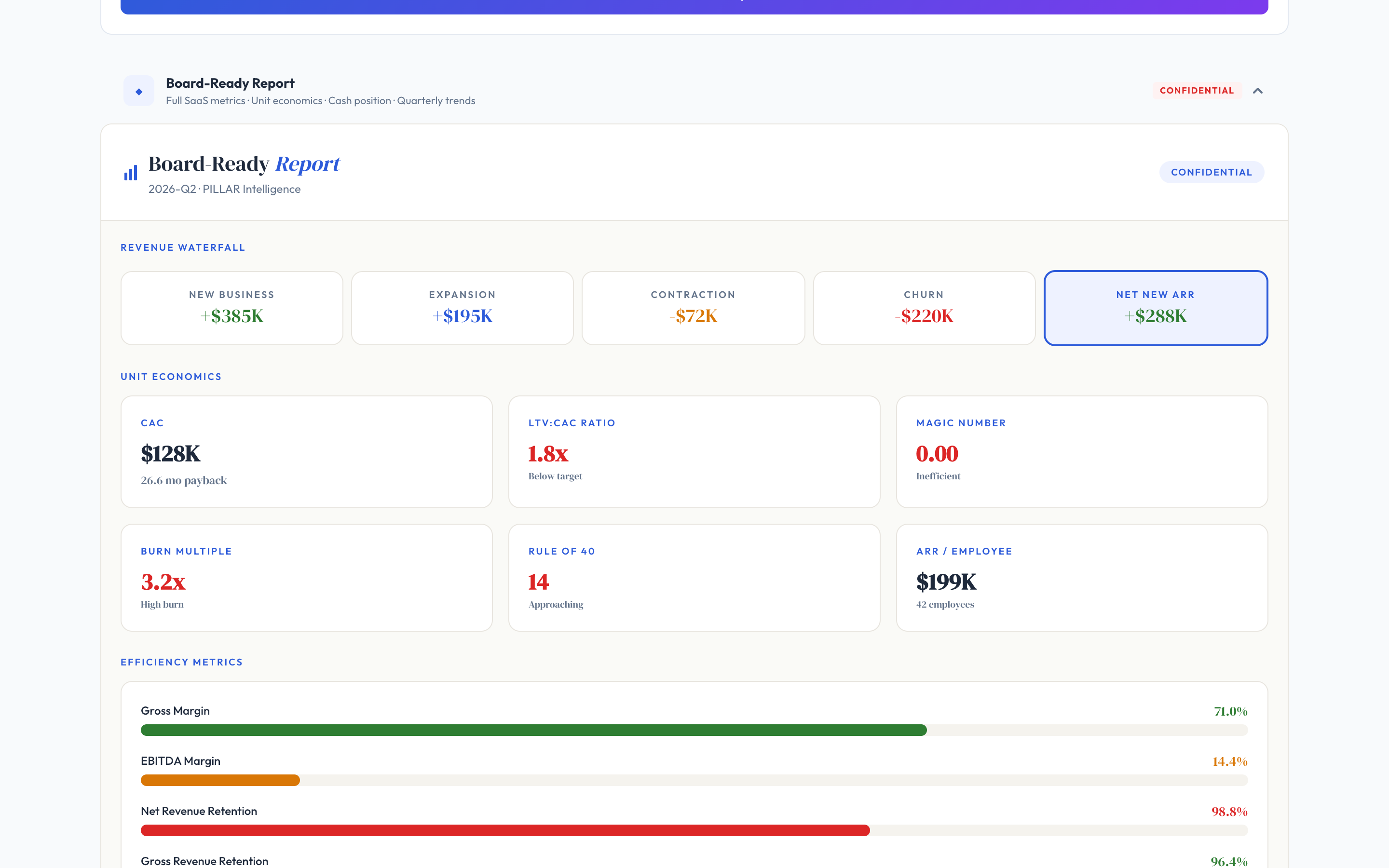
CRO / CEO - Board-Ready Report
The board deck, generated. Revenue waterfall (new business, expansion, contraction, churn, net new ARR), unit economics (CAC, LTV/CAC, magic number, burn multiple, Rule of 40), and an AI-written executive summary - all sourced from the same live data your team operates on.
Connected by Design
Your tools, finally talking.
PILLAR doesn't replace your stack - it listens to it. We pull the records that matter through a field mapping UI you control, run them through the scoring engine, and write the health, risk, and priority scores back to the CRM where your team already works.
Foundation · CRM + Productivity
HubSpot
OAuth 2.0 · Inbound + Score Writeback
PILLAR pulls Companies, Contacts, Deals, Tickets, and your custom properties - with a field mapping UI so you decide what flows. Health, risk, and priority scores write back to Companies so reps see the intelligence inside HubSpot.
Salesforce
OAuth 2.0 · Inbound + Score Writeback
Pulls Accounts, Contacts, Opportunities, and any custom object via SOQL - configurable per object. PILLAR writes health, risk, and priority scores back to Account custom fields. Nothing else is modified.
EdTech Native Partner
Starbridge.ai
Signed Webhook · CRM Passthrough · Native API (coming soon)
PILLAR's deepest EdTech intelligence layer. Starbridge events stream into PILLAR's signed webhook endpoint in real time - RFPs, grant awards, board decisions, stakeholder departures, and budget shifts each become a live signal on the right account the moment they happen, with HMAC verification on every payload. District-level buyer attributes (NCES, enrollment, tech budget, AI adoption, coop agreements, competitor contracts) flow through your CRM today. The native Starbridge buyer & contract API is coming soon - the connector client is already built and ready to switch on the day Starbridge ships their public API.
Google Workspace
OAuth 2.0 · Gmail + Calendar (read-only)
Reads Gmail headers and snippets plus Calendar events (past 90 days + next 30) to track engagement - who replied, who showed up, who went dark. Read-only. No Drive, no Docs, no full message bodies.
Microsoft Dynamics 365
OAuth 2.0 · Inbound + Score Writeback
Pulls Accounts, Contacts, Opportunities, Leads, and Incidents from your Dynamics org via the Web API. PILLAR writes health, risk, and priority scores back to Account custom fields. Supports any Dynamics online org URL - enter your org URL at connect time.
Microsoft 365
OAuth 2.0 · Outlook + Calendar (read-only)
Reads Outlook email headers and Calendar events via Microsoft Graph API to track customer engagement. Same engagement signals as Google Workspace - who replied, who went dark - but for Microsoft-shop customers. Per-user OAuth, no email body content stored.
Microsoft Teams
OAuth 2.0 · Adaptive Card Notifications
Posts signal alerts, daily portfolio digests, and play activation notifications to any Teams channel via Adaptive Cards. Supports both incoming webhook (zero-OAuth) and Graph API (full channel picker). Real-time renewal risk alerts land directly in the channel your team already monitors.
Product Usage Signals · fresh adoption data overrides stale CRM fields
Pendo
API Key · Feature Adoption + Sessions
Pulls feature adoption, visitor sessions, and tracked events via Pendo's integration API. Every scoring run overwrites stale CRM-typed adoption_pct with fresh Pendo data - HealthScore reflects what customers are actually doing in your product, not what a CSM typed 6 months ago.
Mixpanel
API Key + Secret · Events + Funnels
Service Account API pulls event volume, funnel conversion rates, and cohort retention. Declining trends surface automatically in the renewal risk score - no manual tagging, no CSM-maintained dashboards, no quarterly health reviews that drift the day after they ship.
Amplitude
API Key + Secret · Events (US & EU)
Project API Key + Secret pulls behavioral events and user journeys. Supports both US and EU data residency (choose at connect time). Same snapshot-override model as Pendo - fresh usage signal replaces whatever number your CRM has stored for this account.
Segment
API Token + Workspace · CDP Events
Customer Data Platform integration - pulls events your product already forwards through Segment (web, mobile, server SDKs). Zero new instrumentation. PILLAR classifies incoming events into adoption + engagement signals and feeds them into the product usage snapshot pipeline.
Heap
API Key · Auto-Captured Analytics
Auto-captured product analytics with zero instrumentation on your side. Heap's API key gives PILLAR session counts, feature adoption, and behavioral events - feeds the same usage trend snapshot pipeline as Pendo, Mixpanel, Amplitude, and Segment.
Mode Analytics
API Key + Secret · BI Reports + SQL
Pulls scheduled report output from Mode's REST API using HTTP Basic Auth. Auto-detects adoption and engagement columns from report CSVs, maps them to accounts by domain or ID, and writes product usage snapshots - ideal for teams whose product analytics live in a BI warehouse rather than Pendo or Mixpanel.
Customer Sentiment · NPS and satisfaction scores feed directly into account health
Wootric (InMoment)
OAuth 2.0 Client Credentials · NPS Responses
OAuth 2.0 client credentials flow pulls NPS responses, aggregates by email domain to the account level, and computes a real NPS score (% promoters minus % detractors). Writes directly to accounts.nps_score so account health reflects actual customer sentiment - not a CSM's gut feeling.
Delighted
API Key · NPS + CSAT Surveys
API key via HTTP Basic pulls NPS and CSAT survey responses. Same domain-level aggregation as Wootric - maps individual responses to accounts, computes NPS, and writes the score. Switch between Wootric and Delighted without reconfiguring scoring; both write the same nps_score field.
Support Ticketing · computeSupportBurden drives the renewal risk score
Intercom
OAuth 2.0 · Conversations + Tickets
OAuth flow pulls support conversations, ticket severity, response times, CSAT scores, and escalation metadata. PILLAR's computeSupportBurden aggregation turns these into the support_burden component of every account's renewal risk score - the only support tool connector with a full OAuth flow.
Zendesk
API Token · Tickets + SLA + CSAT
API token pulls tickets, SLA metrics, CSAT scores, and escalation data. Open critical tickets, low CSAT, and frequent escalations drive the support_burden risk factor - fires the "support crisis" signal + auto-creates an escalation task the moment 3+ P1/P2 tickets are open simultaneously.
Freshdesk
API Key · Multichannel Tickets
Multichannel support tickets, customer satisfaction data, and priority routing metadata via API key. Same snapshot shape + aggregation model as Intercom and Zendesk - PILLAR writes a single support_burden score per account regardless of which support tool you use, so you can switch tools without re-calibrating scoring.
Call Intelligence · conversation analytics power a new scoring category
Gong
OAuth 2.0 · Call Analytics · Available
Unlocks the Call Intelligence scoring category for PILLAR customers on a Gong plan with API access. Seven scoring rules (CI-001 through CI-007) evaluate every recorded conversation: rep talk-to-listen ratio, customer sentiment trends across calls, competitive mention detection, next-steps commitment tracking, executive stakeholder participation, call frequency relative to deal stage and renewal proximity, and customer engagement depth. Call data syncs every 4 hours via OAuth 2.0 (authorization_code flow); tokens are stored encrypted at rest. Calls marked private by the call owner are filtered at ingest and never stored in PILLAR, matching the Gong Collective marketplace requirement. Accounts where reps over-talk, customers go silent, competitors surface, or next steps are missing are automatically flagged as at-risk — with the specific conversation evidence attached to the signal.
OAuth 2.0 secured
Field mapping you control
Scores write back to CRM
Encrypted credentials at rest
Data Health Dashboard
Trust starts with clean data.
Before PILLAR scores a single account, it audits your data. Missing fields, stale contacts, orphaned deals, inconsistent stages - all surfaced with a clear path to fix. Your team sees exactly what's healthy and what needs attention.
Field completenessStale record detectionStage consistencyDuplicate resolution
Data Health Score
155 accounts audited
84%
Contact emails
94%
Deal close dates
87%
Renewal dates
72%
Account owners
91%
District mapping
65%
Next step: 23 accounts are missing renewal dates. PILLAR can infer these from deal history - review and confirm to unlock renewal scoring.
The Architecture
Not another tool. The architecture.
PILLAR OS is the operating layer above CRM. Every signal. Two lenses. One governed engine.
Axonometric / The Revenue Architecture Operating System
FIG. 01
4 LAYERS / END TO END
DRAG TO ROTATE
IVCadencesClick to explore
IIIDecisionsClick to explore
IIScoringClick to explore
ISignalsClick to explore
0CRMClick to explore
Click any layer to explore
IVCadences
IIIDecisions
IIScoring
ISignals
0CRM
▲Data flows up▼Decisions flow downEach layer depends on the one below it.
LAYER 0 · CRM
The foundation. Not the OS.
System of record.
Activity logging.
Pipeline structure.
PILLAR builds the four layers above it.
LAYER I · SIGNALS
See what your CRM can't.
Budget cycles.
FOIA procurement.
Champion departures.
Usage anomalies.
Detected before they break revenue.
LAYER II · SCORING
Every account, scored.
Risk.
Priority.
Readiness.
Every number traceable to evidence.
LAYER III · DECISIONS
From score to action.
Risk becomes ARR at risk.
Priority becomes today's triage list.
Signals become plays with owners and SLAs.
LAYER IV · CADENCES
The operating rhythm.
Pipeline review.
Renewal triage.
Forecast call.
QBR.
Scored inputs. Tracked decisions. Outcomes train the engine.
Start Here
See where your revenue architecture stands.
The Blueprint is a free, 20-minute assessment that scores your GTM maturity across 142 items and 5 pillars. It's the first step to understanding what PILLAR OS can do for your team.
These are PILLAR's own figures: what the platform does, what it costs, and what we have measured inside our own deployments. They are first-party claims rather than independent measurements or market benchmarks, and nobody has audited them but us.
Figures describing school districts, their funding or their spending come from public records and carry their source where they appear.
Anything describing value delivered is an outcome we have observed, not a guarantee of yours. Every figure here is covered by our standing correction offer.